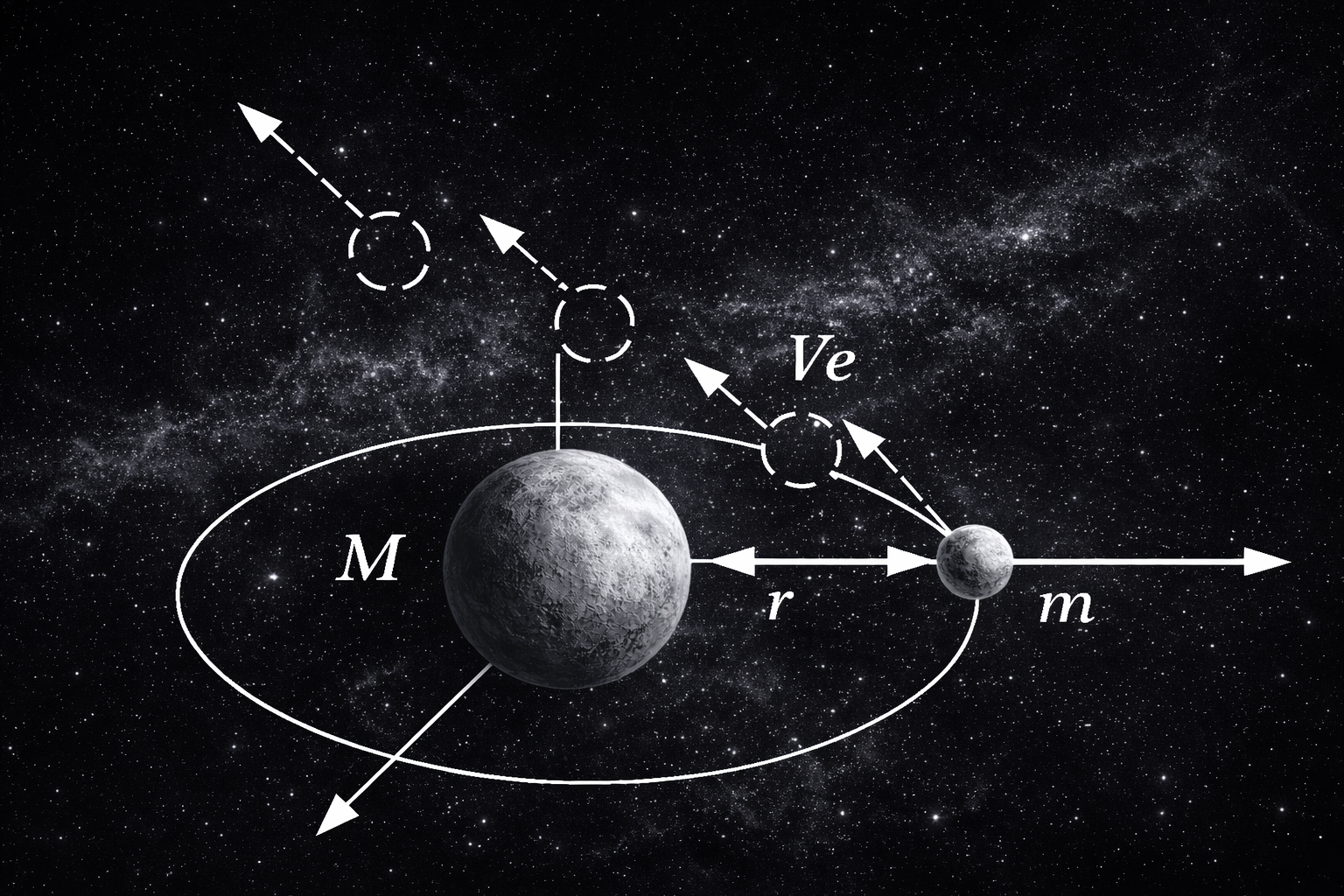
In celestial mechanics, escape velocity refers to the minimum speed a body must achieve to overcome the gravitational pull of another object.
GRAVITY
I first felt the tug of gravity when I was five years old. Until then, I floated in the protective bubble of a two-parent home, unaware of the strong forces at play in the world. I have seen the pictures. I was well loved. Unfortunately, my parent’s relationship did not endure. Sometimes it goes that way, but their split pierced my bubble all the same. Atmosphere rushed in, and I suddenly felt the weight of things.
My mother and I took up in an old hunting cabin. She acquired the glorified shack for a pittance and made it livable. We were living year-round in a glorified shack with the R-value of a potato chip bag, but, Christ, what a view. I’m now positive “the camp” violated a slew of building codes by sitting as close to the water as it did like an endangered bird nested somewhere inconvenient but immovable. Grandfathered in as they say. It was crooked, cozy, and cold in the winter, but the surroundings were amazing. Nature made a fine companion for an only child. The moment I stepped out the front door I had water and woods; stillness and silence.
My dad lived three miles away in town with my grandparents whose long, one-story home functioned as a side-by-side duplex. My grandfather lingered in failing health and my grandmother lacked mobility, so my dad helped care for them. Undoubtedly, the arrangement was also a financial one that allowed my dad to keep up with child support payments and to save for his future and mine, though I was unaware of this dynamic until much later in life.
I can’t quite pinpoint when things began to deteriorate. Perhaps after a few years of living alone. My mother did not have a support system. She ceased contact with her parents abruptly and I couldn’t talk about them anymore. She quit her job, and, after, could not hold one down for more than a few months. I didn’t understand what was happening but realized it was still going to be my problem. My mother needed to vent to someone about our prevailing financial woes, her anger towards my father, and a variety of other topics best suited for a professional or someone who measured their age with more than one digit. She opted for a captive audience.
As time passed, she became fully unbalanced. Nothing could be certain. Not her mood, not the availability of heat or electricity or a working vehicle, not the right thing to do or say in any situation to avoid an explosion. Existence felt like defusing a series of bombs. If I could just cut the right color wire in the right order maybe today would be okay. The one constant was her hatred of my father; it hardened like a cancerous diamond in a crucible of loss and blame and surpassed reason, proportion, and her concern for me. Bouncing between the chaos of her custody and the stability of my dad and grandparents was jarring. I found myself stuck on a ducking stool like some medieval wrongdoer, bound to a chair and lowered again and again and again into an icy river, held aloft just long enough for a lungful of air before being plunged back into a dark current of chaos.
I remember the hard ritual of getting dropped off at my mother’s house. (I know my dad does as well because we still talk war stories from time to time like ‘Nam vets reminiscing at the VFW). My designated nights with him often felt like prolonged countdowns. The mood would shift at six o’clock with the chiming of the wall clock on my grandparent’s side of the house. That meant we had thirty maybe forty more minutes to keep playing cards. After that, my dad and I would return to his side and wait for her to call. Sometimes the call never came. Other times, she would just say, “You can keep him” or something nice like that. Either meant I could stay, which was a tremendous stroke of luck; like staring down a firing squad with wet gunpowder. More often than not, though, I would have to go back home.
I tried to gather bits of data from the timing of her call and its duration, but the tone of my dad’s voice on the phone and the look on his face told the tale. It’s better to know what you’re in for. After that, there was nothing left to do but get in the truck and go. I don’t remember talking much on those rides, but I do recall the mood. Somber. Reluctant. Like taking an animal to the vet. I knew all the turns. The distance between landmarks. I even knew the points in the road when my dad would shift gears as the small engine of the Nissan pickup began to strain. I savored that drive like a last meal making minutes into hours in my mind.
After ten or eleven minutes ticked by on the blue digital dash clock, we would reach the top of the long, dirt driveway leading down into the woods and terminating in a pitch black clearing. I would drag out the goodbye, but, in time, I lingered less. I had to leave, so I learned how to go. I let something else inside me take over. It told me don’t think. Disengage. Unfasten seatbelt. Short hug. Long breath. Exit. Orient to footpath. Three steps, big root, step, step, small root, step, step, six stone steps. Reach threshold. Look back. Watch red taillights disappear. Just me now. Control face. Regulate breathing. Steady now. Shields up. Get stony! You are a stone from the river! You’re a stone, god damn it! Now, turn the knob.
GATHERING SPEED
In Kindergarten, I was an odd duck. I wouldn’t talk in class; I just sat and listened. This went on for weeks. I knew the answers to the questions, but I needed to see how things worked. I waited and watched, noting who got questions right, who got them wrong, and what my answers would have been. Most of all, I watched how my teacher reacted. Nothing bad ever happened to anyone, right, wrong, or otherwise. She never yelled. In fact, she seemed very kind. I think I probably loved her. Most days she would ask if I wanted to talk, but I would shake my head no, and she would say that it was okay, that I didn’t have to talk if I didn’t want to. It took a long time, but, one day, I was ready. I raised my hand, spoke, and everything was okay.
I grew to trust and love school. I valued the seven or so hours of guaranteed structure and safety. I was free to speak, free to question, free to be silent; free to be right or wrong, whichever the case might be, without risk of reprisal. My teachers praised me when I was clever or kind and corrected me gently if I did something wrong. “This place makes sense,” I thought. I was shown what I had to do for affection and approval, so I did it. The more I did it, the better I got at doing it, and the more I came to depend on it.
By middle school, my self-worth flowed primarily from academic achievement. The further along the prescribed path I went, the more praise I received: people told me I was smart, recognized that I was capable, acknowledged, even, that I was good. I liked these feelings and I liked that I had some control over them. When I did “X,” I almost always got “Y.” I could brew myself a wonderous ego-boosting tonic and drink it down over and over and over again with every “A” grade, award, and perfect score. But ego was not my sole motivation; there was a grander design.
For me, accruing knowledge was like a whore secreting jewels. Intelligence was my getaway money, and, unlike precious stones, this form of capital could not be confiscated. No one could stop me from learning, and no one could take my learning from me. Of course, I could still be punished for possessing or displaying it. Contradictory reasoning, even if solicited and sound, still triggered unhinged soliloquies and far worse from the woman whose twisted custody I fell under. It had become clear on a conscious, actionable level, that I needed to get away.
My neck bent under a necklace of millstones: the quiet desperation of my small hometown, the profound frustration of part-time poverty, and the punishing flails of a woman stubbornly drowning in untreated mental illness. But how to break free? Running away seemed a poor long term strategy. High risk, low reward, likely unsustainable. I still had my dad. I could do better. My strength was my mind, I just needed to endure. Escape was simply a matter of having enough jewels to barter with when the moment came.
By high school, life had improved. Slowly, surely, I had built an iron sense of agency formidable enough to eliminate any trace of dependency on anyone or anything. When I turned sixteen, got my license, and got a car, that was it. I could exert my own autonomy. I was mentally strong, remarkably capable, and dead focused. I had a few bosom friends, was a varsity athlete, had a nice girlfriend with a nice family and a long list of adults I respected that knew me as a good kid and a winner. With momentum and direction I just needed one good chance to get gone.
BREAKING AWAY
Senior year, I got my shot. College acceptance letters arrived, several scholarship applications panned out, and a financial aid package from one well-regarded liberal arts school far enough away from Maine looked generous enough for the math to work. I figured I’d only be knee deep in student loan debt after graduating rather than up to my eyeballs, but I gave only a scant fuck for matters of accounting at that time. I had an out, and I accepted it gratefully. My first long war was won, but there was a final engagement that required a surprising amount of courage.
Highschool graduation loomed, and I had to speak. I still think it’s odd to have a seventeen year old opine to a gymnasium full of adults about life. My favorite teacher offered me solid speech-writing advice: “Just keep it fucking short. I don’t want to watch you die a slow death up there.” Noted. I was so nervous the day of that I considered skipping the whole thing, but I nixed the thought immediately. To have come so far only to end the campaign in cowardice? No. Fuck that. Turn the knob. I threw up, suited up, and feigned confidence all the way to the stage.
To my deep chagrin, I had to follow the commencement speaker, a friend whose father died during our junior year. He spoke well. Not a dry eye in the house. Applause thundered well after I reached the podium. I felt a grim certainty that I was about to eat dirt. My speech was just a long series of jokes. I don’t know how, but the audience transitioned from tears to laughter seamlessly. I guess it makes sense in retrospect. I wasn’t some seventeen-year-old demagogue; the crowd just needed a release of emotion. I spoke about the mundanity of our lives as students: quirks of our old school building; peculiarities of the faculty. It was an invitation to see the humor in life, and, in the fine print, an explanation of what kept me going.
After the crucial first laugh, my nerves faded, my voice carried, and I got through it. Perhaps I even killed, but the heart’s furnace puts a glow on such memories that make a narrator unreliable. Traditionally, the class valedictorian delivers the final address (known as the valediction, from the Latin, vale dicere, meaning “to say farewell”). The speech is intended to serve as a farewell address that reflects on the shared experiences of the graduating class. I was not the valedictorian, but I’ll be damned if mine was not the valediction that afternoon.
Two months later, I made the 700-plus mile drive to the college campus I would call home for the next four years. I hopped in my ’97 Saab at the pale, promising ass-crack of dawn, fired up the engine, and took off. Navigation consisted of directions scrawled in pencil on a 3×5 index card. For provisioning, I had a bag of beef jerky and a full case of seltzer. Finally, for entertainment, there was “The Brick” (an MP3 player my dad gave me whose capacity was exceeded only by its astonishing density). The trip marked not only my first time leaving home, but, to my knowledge, it was the first time anyone in my family had left the state at all for any significant length of time. Let it be me then. I will go.
Bombing along I-90 West through the picturesque, repetitive countryside of New York State at a smooth seventy-five, I saw signs for Ithaca and considered the journey of the Grecian king who ruled the city’s ancient namesake. I remember laughing at myself. It takes a cheeky sort of prick to draw comparisons to Odysseus a few hours into a one-day trip. Whatever. This was my grand adventure. I shook my head and patted the dashboard of the Saab: “You’re doin’ good, girl. We’ll get there.” After twelve hours and two tanks of fuel, we touched down. Groaning, I hoisted myself out of the car to stand as far away from home as I had ever been. With tingling legs, I took a few hobbling steps. It felt like walking on the moon.
Onward. Always.
Half Good Hiker